

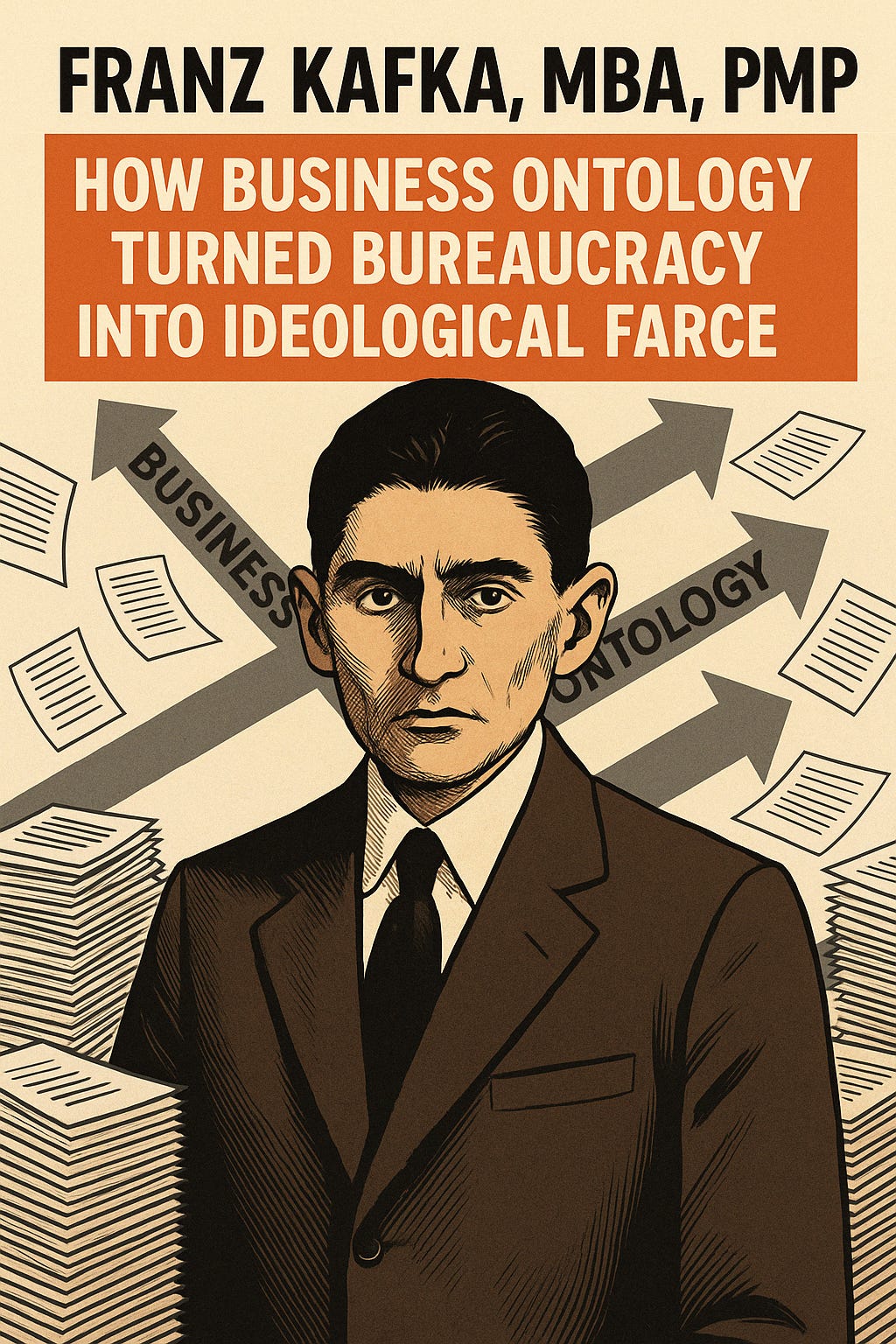
Franz Kafka, MBA, PMP.
How Neoliberal Business Ontology Turned Bureaucracy into Ideological Farce

By Patrick Allen, Ph.D.
Sir, please fill out this form…
Now print your name here, here, and—yes—also here, even though it already says “see attached.” Sign on page 4, but don’t initial page 2 unless it’s Tuesday. Great. Now mail it in, wait four months, and eventually receive a letter telling you it was rejected because you used blue ink instead of black. Try calling the helpline: average wait time, six hours. The agent will direct you to a different department, which refers you to an outdated website, which links to a PDF that crashes your browser. To protect your privacy, and ensure compliance with our commitment to “respectful, person-centered service delivery,” please now read this 400-page Terms and Conditions document that contradicts itself five times and refers to policies that no longer exist.
This is not the exception. This is the system.
Philosophically, at the core of this system is something Mark Fisher called business ontology: the idea that institutions should model themselves on corporate structures, logic, and language—not just in form, but in being. It's not just that public services imitate businesses; it's that they now conceive of themselves as businesses. Governance becomes brand management, service becomes product delivery, and the citizen becomes a client. This ontological shift isn’t cosmetic—it rewires how institutions understand purpose, value, and success. And the result is a world where justice is measured in KPIs, care is routed through cost centers, and failure is blamed on the customer for failing to “engage.” What used to be a mechanism of rational administration has become a deranged theatre of process over outcome, performance metrics over human judgment, and “change initiatives” that change absolutely nothing. Bureaucracy was once designed to eliminate bias and personal whim—now it’s a slow-moving ideological meat grinder. In neoliberalism’s final stage, bureaucracies have become simulacra of governance: systems that appear to function, speak in human words, and wear the mask of purpose—while doing absolutely nothing but circulate their own internal waste.
And that’s not dysfunction. That’s design. This isn’t bureaucracy gone off the rails—it’s neoliberal bureaucratism fulfilling its real purpose: to depoliticize decisions, displace responsibility, and ensure that every structural injustice becomes an individual administrative problem.
The Bureaucrat as Ideological Functionary
Neoliberal bureaucrats aren’t evil in the cartoon sense. They are functionaries of ideology, tasked with safeguarding the credibility of institutions that no longer serve human needs. Their power is not visionary but procedural. They survive not through ingenuity or merit but through their ability to absorb critique and reroute it into meaningless “engagement processes,” which are often soaked in paperwork, arbitrary formality, and attrition through time-wasting and organizational inertia.
Bureaucrats of this kind do not govern. Governance requires accountability and ethical appraisal. Instead, they manage—with all the epistemic emptiness that implies. Their primary competency lies in risk deferral, in ensuring nothing changes while pretending simultaneously that everything is in motion. Every crisis becomes a “deliverable.” Every failure becomes a “learning opportunity.” Every act of sabotage is just policy and “the process.”
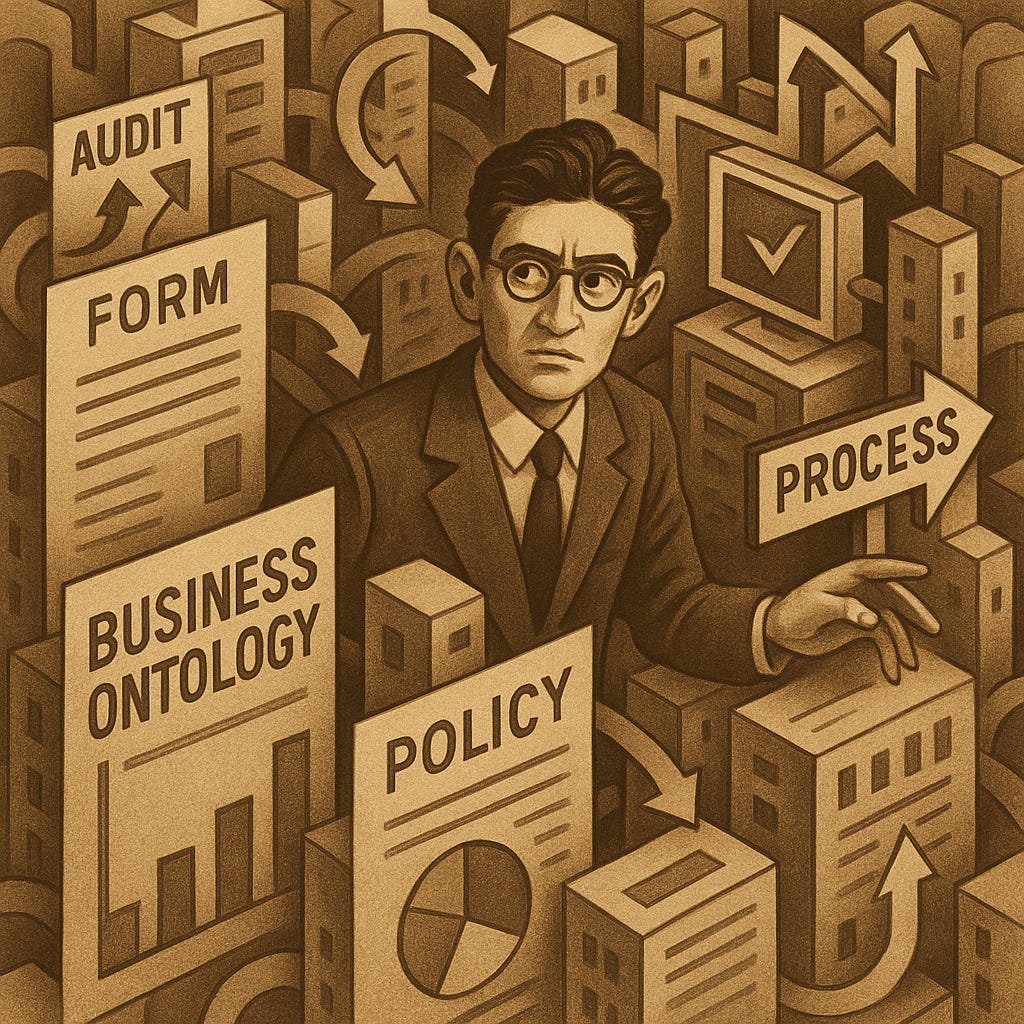
Neoliberal Bureaucratism as Ideological Control
The administrative absurdity described above isn't just the result of poor design—it’s ideological infrastructure. Bureaucracy under neoliberalism isn’t broken; it’s functioning exactly as intended: not to solve problems, but to manage and distribute blame for them. It doesn’t process justice, care, or equity. It processes you.
As I’ve argued elsewhere, one of neoliberalism’s most insidious achievements is its co-option of anxiety: to manufacture it structurally, medicalize it individually, and monetize it therapeutically. Bureaucracy is central to this project. It is not a neutral mechanism of service delivery—it is the nervous system of psycho-political control.
It’s not simply that bureaucracies are inefficient—they are efficient in their inefficiency. The friction is the point. The waiting, the contradictions, the dead ends—they’re not anomalies, they’re technologies of subjection. They wear you down, inculcate helplessness, and produce an affective relationship to the state rooted not in trust or solidarity, but in confusion, anxiety, and passive compliance. You are trained, through repetition, to internalize systemic failure as personal failing.
As I argue elsewhere:
“The bureaucracy of neoliberal capitalism creates distresses through precarity, austerity, and class oppression. Such anxieties then are marketed as the problem of the individual [...] The psy-professions, as part of the feedback cycle, then turn the cycle to chase its tail [...] thus distresses are often never considered as linked to externalities” (Allen, 2022, pp. 34–35).
This is the core function of neoliberal bureaucratism: to transform structural violence into procedural formality, and then to outsource the consequences to the individual. You didn’t get the benefit, the appointment, the job, the exemption—because you filled the wrong form. You didn’t follow “process.” Or worse: you just weren’t resilient enough.
And so, what might have once been political becomes bureaucratic. What was once a matter of injustice becomes an “administrative error.” And what should be a collective demand becomes a private case file.
From Weber to Audit Culture: A Necrotic Transformation
Max Weber envisioned bureaucracy as a rational, impersonal apparatus—one that would neutralize corruption, curb personal whim, and standardize governance through rules and procedures. It was meant to ensure fairness through formality. What we have now is a grotesque parody of that vision: a sprawling zombie machine that still moves, still clicks, still files reports—but with no soul, no purpose, and no capacity for justice.
We get performance targets without performance.
Stakeholder consultations that exclude actual stakeholders.
Change management strategies whose sole function is to perpetuate the need for change management strategies.
Each layer of process is another coat of white paint over a rotting foundation.
This isn’t just bad design. It’s not incompetence. It’s ideological infrastructure. Neoliberal bureaucratism has perfected the art of appearing to act while structurally preventing any real action. Fisher’s “capitalist realism” lives here in pure form: it’s easier to imagine the end of the world than the end of a five-year strategic plan that no one reads and no one believes in. In this reality:
The audit replaces the outcome - it is the ‘outcome’.
The survey replaces the decision - it is the ‘decision’.
The manager replaces the expert.
And—crucially—the process replaces the political.
What we’re left with is governance as paperwork: a looping ritual of empty consultations, politically sterilized and inoffensive buzzwords, and metrics no one understands but everyone pretends to believe in. This is not administration—it’s ideological theatre, staged to neutralize dissent and displace accountability while the building burns down around us.
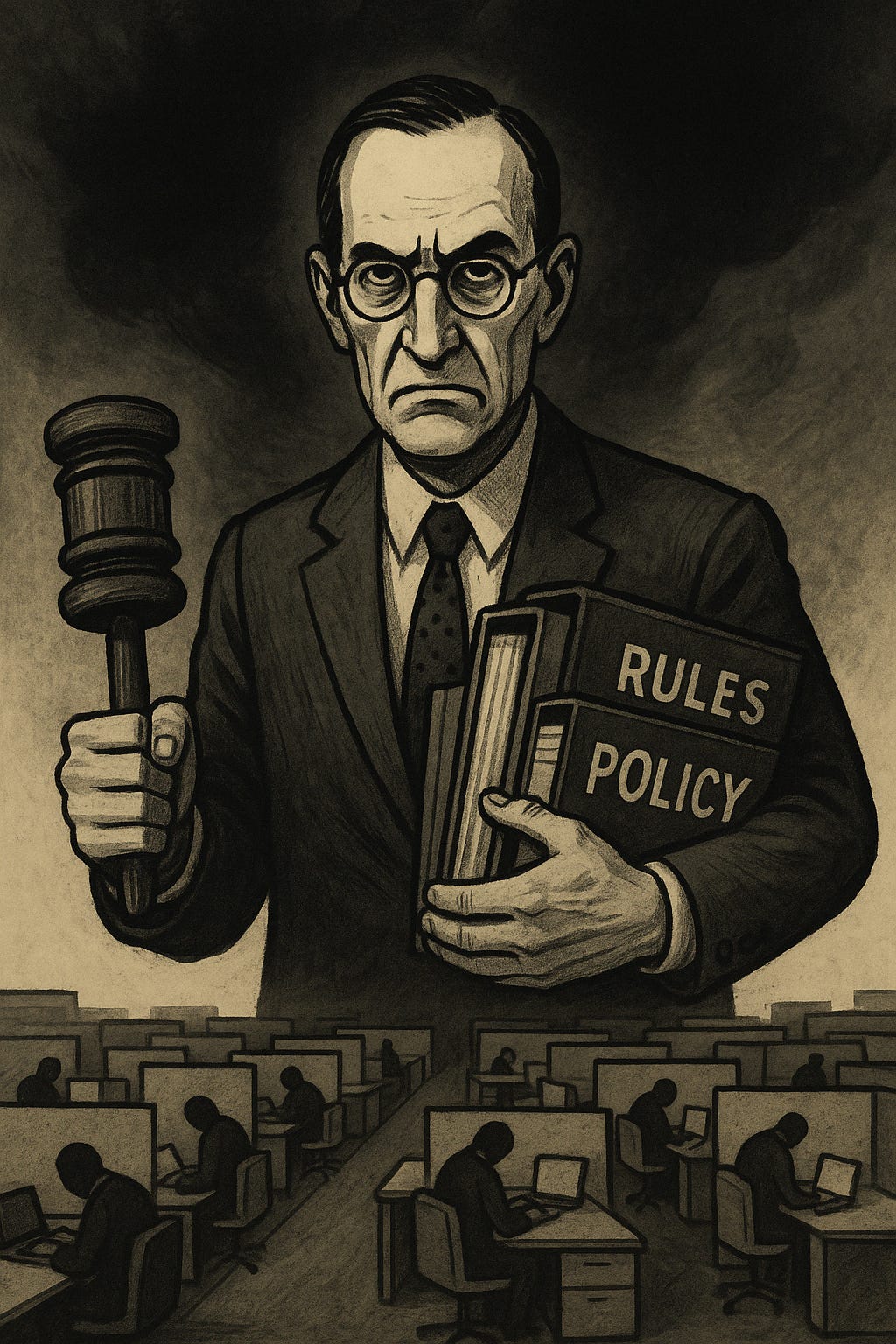
Bureaucratic Sadism and the Technocratic Void
Byung-Chul Han, in The Burnout Society, writes that we’ve moved from disciplinary societies—defined by prohibition and punishment—into achievement societies, where the subject is compelled not by coercion, but by internalized pressure to perform. Under neoliberalism, the state no longer says, “You must”; it says, “You can.” But what it really means is: You must do everything, and if you fail, it’s your fault for not doing it well enough.
Neoliberal bureaucratism is the purest expression of this logic. It’s no longer about being ruled from above—it’s about managing your own submission. You must self-assess, self-improve, self-report, self-blame. You must align your values with the brand. You must demonstrate “learning agility” while enduring institutional stagnation. You must demonstrate resilience while being atomized, surveilled, and demoralized by a process that was never designed to serve you.
Failure isn’t a feature of the system—it is assigned to the subject.
You didn’t align your goals with the organizational strategy.
You missed a checkbox on the intranet form.
You didn’t complete the mandatory micro-learning on “Psychological Safety in the Hybrid Workplace.”
You forgot to log your fatigue as a “learning opportunity.”
Burnout? That’s a branding problem. A temporary mindset. A coaching issue.
As I argue in my thesis:
“The culture that neoliberalism inculcates results in iatrogenesis. Specifically, neoliberal ideology transforms and territorialises negatively valued human affects into problems for which it also offers the ‘solutions’.” (Allen, 2022, p. 10)
Neoliberal bureaucratism manufactures psychic injury—then denies it, then markets the remedy. You’re disoriented, exhausted, and spiritually obliterated? Not because your life is crushed by debt, stagnation, and procedural nihilism—but because you haven’t done enough “self-work.” Instead of interrogating why the system is devouring us, we’re told to optimize our time blocks and practice gratitude journaling.
The cruelty is the model.
The paperwork is the therapy.
The bureaucratic void is filled with performative care—the wellness webinar, the "wellbeing champion," the PDF on how to breathe.
And this is the real stroke of genius: neoliberal bureaucratism creates the wound, denies it exists, and then sells you a Band-Aid—for violating dress code.
Why It Feels So Much Worse Now
Because it is.
The decline isn’t imagined—it’s structured. In Canada (and across much of the bureaucratic West), the institutional architecture hasn’t merely calcified—it has fossilized. What remains of the public sector is not a machinery for delivering justice, care, or function—it’s a decomposing exoskeleton, held together by acronyms, managerial bloat, and policy documents that read like rituals of denial.
It no longer exists to do anything. It exists to manage its own decay.
The number of managers grows in inverse proportion to the number of people doing meaningful work. The more acute the crisis, the more elaborate and absurd the bureaucratic response. One director fails? Create two new executive roles to ensure “governance alignment.” A service collapses? Commission a 200-page strategy document with the word “transform” used 46 times and the word “justice” never. A public outrage? Announce a new task force with no mandate, no power, and no memory of why the last ten failed.
Each failure generates not correction but ceremony.
This is no longer governance—it is a ritualized economy of reform. Change is the product. The performance of responsiveness becomes its own deliverable. Reports are filed not to improve conditions, but to give failure somewhere to hide.
And the ultimate heresy? The mere suggestion that something is very wrong and that the system itself must be dismantled. That perhaps what’s failing cannot be restructured—but must be abolished. That maybe the thing rotting isn’t the paint job but the foundation. That maybe—just maybe—you can’t fix institutional sadism with another cross-ministry working group.
But that is precisely what’s not allowed. The system has only one sacred value: itself. It will do anything to protect its existence—except change.
So What’s the Way Out?
There are no reforms that can save this. No toolkit, no five-point plan, no softly worded HR memo about “resilience.” Neoliberal bureaucratism doesn’t need improvement—it needs an exorcism.
We are not witnessing a system in need of repair. We are living inside the ideological husk of a once-functional apparatus, now animated only by its own circular self-preservation. What we need is not a consultation on better practices—we need a categorical rejection of the pillars propping up this undead regime:
Audit Culture
The audit has replaced judgment. We no longer ask whether something works—we ask whether it was measured. Bureaucracies now exist to produce data about themselves, for themselves, while the actual services rot in plain sight.
This obsession with metrics is not about transparency or accountability—it’s about control through abstraction. It’s the bureaucratic form of magical thinking: the belief that quantifying failure somehow negates it. When in doubt, create a dashboard. When something breaks, schedule a town hall and draft a “lessons learned” memo that will be buried in a SharePoint folder no one can access.
Kill the audit. Bring back responsibility.
Pseudo-Consultation
You’ve seen this farce: endless surveys, “engagement sessions,” and stakeholder forums that simulate democracy while carefully excluding dissent. Under neoliberal bureaucratism, consultation is not about inclusion—it’s about the performance of inclusion.
You’re not being asked for your input. You’re being asked to simulate consent. The decision has already been made. Your role is to rubber-stamp it with a smile and a buzzword.
Consultation that excludes critique is not participation—it’s ritualized gaslighting.
Business Ontology
This one runs deep. Neoliberalism’s ultimate ideological move was to redefine the public as private—not just in ownership, but in ontology. It’s not just that services were privatized; it’s that even public institutions began to think like businesses.
Schools become “education providers.” Hospitals become “health networks.” Ministries become “brands.” People become “clients,” “human capital,” or worse, “stakeholders.” And governance becomes an exercise in strategic alignment and brand management.
But public institutions are not broken businesses—they are not meant to generate profit or optimize throughput. Their value cannot be captured by KPIs. Business ontology imposes a logic that is fundamentally incompatible with justice, care, or truth.
Efficiency becomes more important than equity.
Optics override outcomes.
And moral responsibility is outsourced to the PR team.
This is why public sector work now feels like bad corporate cosplay—because it is. The spreadsheet became the sacred text, and everyone forgot how to speak like a human being.
We must destroy the idea that public goods should act like corporations. Governance is not a start-up.
Depoliticized Governance
Perhaps neoliberalism’s most cunning maneuver was convincing us that politics is just administration. That technocrats are “neutral.” That policies on housing, health, and incarceration can be crafted without ideology.
But neutrality is a lie. Every spreadsheet is ideological. Every risk assessment encodes value judgments about who is disposable. Every “evidence-based policy” rests on metrics that render suffering invisible and make injustice look like optimization.
We must re-politicize administration and name power where it hides—in process maps, funding models, and risk matrices.
Managerial Sadism
This one needs no introduction. You’ve lived it.
The blank stare from a senior manager as they “thank you for your vulnerability” and deny your request. The culture of fear branded as performance excellence. The spreadsheet that becomes a disciplinary tool.
Neoliberalism doesn’t need monsters—it needs middle managers who can weaponize ambiguity with plausible deniability. Sadism is no longer a character flaw—it’s a competency.
We need to stop mistaking cruelty for leadership. Managerialism is structural cowardice in a suit.
Mental Health as Compliance Tool
The psy-complex has been fully captured. Wellness has become another form of pacification. You are offered breathing exercises while your team collapses. You are encouraged to journal while navigating institutional violence.
Therapy becomes adaptation to the unlivable. Pathology becomes a substitute for politics. And burnout? That’s just a branding problem. A you problem.
The goal is not to cope with the system. The goal is to abolish what makes us need to cope.
Resilience Rhetoric
Let’s be clear: resilience, in this context, means tolerating more exploitation without complaint. It’s branded as empowerment, but it’s just internalized austerity. It means learning to breathe through betrayal, to smile through collapse.
Resilience becomes a virtue when solidarity becomes a threat.
Forget resilience. We need resistance.
Eternal “Transformation”
The system will never admit it’s failing. So it rebrands. Constantly. It reshuffles executives, rolls out new logos, and launches “transformation initiatives” that transform nothing.
This isn’t change—it’s bureaucratic shapeshifting. An endless loop of internal innovation theatre designed to delay collapse, not prevent it. New strategy, same rot.
We don’t need transformation. We need rupture.
‘Next Steps’
Neoliberal bureaucratism is not a system glitch—it’s the embalming fluid of a dead political imagination. It props up the decomposing remains of a failed economic theology, dressing collapse in spreadsheets and calling it “transformation.” We are no longer governed—we are managed. Not by visionaries or ideologues, but by credentialed functionaries who confuse governance with workflow and purpose with policy compliance.
These are not leaders. They are clerks of decay.
Their language is procedural. Their ethics are conditional. Their power lies in denial, delay, and the ritualized performance of care through checklists, dashboards, and stakeholder memos no one reads. Bureaucracy doesn’t just administer failure—it mystifies it. It breaks you, then hands you a survey.
And this is the point. Bureaucracy isn’t meant to solve the problems of neoliberalism—it’s designed to domesticate your rage, to convert political contradiction into clerical burden. To transform demands for justice into time-consuming tasks. It buries collective suffering in individual case files, then sells you resilience training when you collapse.
This is not governance. It is ideological euthanasia.
If we are to reclaim anything resembling a future, we must stop trying to “improve” this machinery. You cannot streamline your way out of spiritual death. The question is no longer how to fix the system—it’s whether we are willing to name it, reject it, and walk away from its rituals altogether.
Not reform. Not restructure. Refusal.
Patrick Allen, Ph.D. is a philosopher, consultant, and writer whose work engages in political philosophy, political economy, critical theory, and psycho-politics. His research spans the cultural, institutional, and ideological forces shaping public policy, culture, and society.